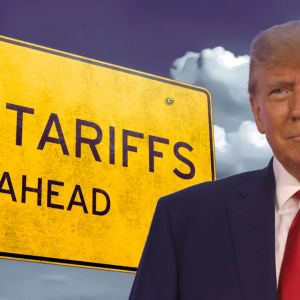
Trump’s victory was celebrated but not by nations like China. Reason being? His tariff history and current tariff promises. Tariffs are a tool that President Trump and his team are well-acquainted with. They have used it extensively in trade negotiations with China in 2018-2019, and they were successful. Safe to say tariffs will be used in the next 4 years. Trump’s appointed team is more pro-tariff than not. The thing about his whole team is that they mostly view tariffs as a tool for negotiation. Well, this explains why Trump takes the same stance. Trump promised to impose tariffs of 25% on all imports from Canada and Mexico and an additional 10% tariff on all imports from China when he takes office. 🇺🇸THE ART OF THE TRUMP TARIFF: A HISTORIC BLUEPRINT FOR WEALTH? Trump claims tariffs once made America wealthy, pointing to the pre-income tax era when they dominated federal revenue. Data shows tariffs peaking as the primary income source during the Second Industrial… pic.twitter.com/y6rPfV0INH — Mario Nawfal (@MarioNawfal) January 2, 2025 Tariffs reduce the volume of imports and are subject to evasion and avoidance. This directly lowers tariff revenue, and it reduces real income, which lowers other tax revenues. Still, the slogan for Trump’s government is to make America great again. Whenever the US imposes tariffs, the world remembers how powerful the US is. Who is advising Trump on the issue of tariffs? Trump’s team stance on tariffs Howard Lutnick starts our list. He was appointed for commerce and is pro- tariff . In fact, if the Senate approves the billionaire investor, he will play a crucial role in implementing Trump’s proposal to impose widespread tariffs on the nation’s trading partners. According to Lutnick, tariffs are “an amazing tool,” intended to be used against allies and rivals in order to push them to adjust their trade policies. In an interview he clarified that, although Trump was too bold about tariffs in his campaign he must administer them strategically not across the board. In the same light, he has discussed tariffs determined by specific products. This policy would match the tariffs imposed by other countries on US products with reciprocal tariffs on their own products—product by product. However, he has stated that tariffs should be added on US-manufactured products rather than tariffs on products not manufactured by the US. Another major tariff optimist is Jamieson Greer, who was appointed as the US trade representative. Apparently, he’s mainly focused on China and was part of the team that enacted the first round of tariffs in 2018. Greer recently criticized Beijing’s trade practices, raising the alarm about their impacts on the US manufacturing sector. Considering his then-and-now stances, he is a Chinese tariff maximalist. The third one has to be Scott Bessent. He was appointed as Treasury secretary. He was also an advisor for Trump’s campaign. This shows that he has an influence on the president-elect’s current stance. Apparently, he also sees tariffs as a negotiating tool. He claimed that Tariffs should be “well telegraphed in the form of forward guidance to provide negotiating leverage and time for markets to adjust.” He is open to putting tariffs on allies and enemies alike. Next is Kevin Hassett, appointed as the director of the National Economic Council. He shares Scott Bessent’s stance that tariffs should affect both allies and enemies. However, he takes a more bold stance and states that tariffs should go up all at once. In an interview , Kevin Hassett said that other nations should be pushed to either reduce their rate to the US rate or the US go higher altogether. Peter Navarro was appointed as senior counselor for trade and manufacturing. He, too, sees tariffs as a negotiating tool but in a more cautious way. He acknowledges that tariff barriers may be extremely high if other countries fail to negotiate in good faith. This result speaks to the fact that so many of America’s trading partners are applying significantly higher tariffs to thousands of American products. Lastly, Stephen Miran was appointed to lead the Council of Economic Advisers. His stance stands out the most. According to him, tariffs should be used to generate revenue. This is essentially the charge that other nations must pay in exchange for using the US currency as a reserve. Clearly, Trump’s team is into tariffs. Trump takes over on Monday, and tariffs are coming. Mexico benefits from Trump’s China tariffs In his first term, Trump imposed tariffs on billions of dollars worth of Chinese products. As a result, an increasing number of companies relocated their manufacturing operations from China to Mexico. Now, industry analysts and executives who collaborate with Mexican manufacturers have reported a resurgence of interest from companies seeking to relocate production from China to Mexico. This is mainly because Trump has pledged to intensify the trade war. Raine Mahdi, whose company, Zipfox, connects businesses with manufacturers in Mexico, said, “The last time, this issue caught the tail end of the Trump administration, and then it pretty much died off with the Biden administration. Now it’s already starting before Trump is even officially in office. It’s not going to just go away. Companies are not going to be able to wait it out.” Notably, Trump has issued threats to impose tariffs on products from Mexico on the first day of his administration since his election. However, this would constitute a violation of the USMCA trade agreement, which Trump had advertised as a significant negotiation victory during his initial term. Mexico is not too worried because the US will be able to start renegotiating the USMCA pact in July 2026 under a provision in the agreement. If the three countries don’t agree to extend the deal, it will terminate in 2036.