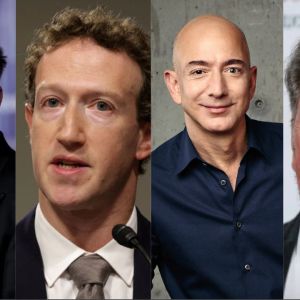
A tiny group of 24 people now hold $3.3 trillion, or 16% of all wealth, an amount equal to the GDP of France. These guys are now called “superbillionaires” by Forbes, because they have a new level of extreme wealth and power. Forbes’ first billionaires list in 1987 had 140 people worth a combined $295 billion. Back then, the richest person was Japan’s Yoshiaki Tsutsumi, a real estate magnate with $20 billion. Today, the world’s richest person, Elon Musk, is worth $419.4 billion, which is 21 times what Tsutsumi had at his peak and over 2 million times more than the median U.S. household. Japan’s Yoshiaki Tsutsumi, widely known as the world’s richest man in 1990 – Forbes Superbillionaires amass extreme wealth To qualify as a superbillionaire, a person needs to have at least $50 billion. Among them, 16 have over $100 billion, making them centi-billionaires. A decade ago, these kinds of fortunes barely existed. In 2014, this group held only 4% of all billionaire wealth. Now, their slice has quadrupled. “Billionaires have always obviously controlled significant amounts of wealth, but now you’re talking about differences in the billionaire population themselves,” said Maya Imberg from Altrata, a global wealth intelligence firm. “It’s quite staggering just how much the net worths of some of these people have grown.” Their money fuels luxury real estate, and every single one of them owns at least $100 million in personal residential properties. That figure is likely understated since many hold real estate under corporate names or through partners. Markets like New York, Los Angeles, Miami, and Aspen have seen a surge in nine-figure home sales and tall residential towers built specifically for the billionaire class. Tech founders dominate the superbillionaire list Most of the superbillionaires made their money in tech or industries boosted by technology. Of the 10 richest people, 6 come from tech, including Musk, Jeff Bezos, Mark Zuckerberg, Larry Ellison, Sergey Brin, and Steve Ballmer. Unlike industrialists of the past, today’s tech billionaires built fortunes based on stock prices rather than physical assets. Their wealth can fluctuate by tens of billions in a single year, depending on investor sentiment. Zuckerberg, Bezos, and Nvidia’s Jensen Huang have all had swings of that scale. Tech monopolies have also helped these billionaires amass their fortunes. Joseph Stiglitz, a Nobel Prize-winning economist, pointed out that current antitrust laws were designed for companies like Standard Oil, not tech giants. “Monopoly power has given rise to the potential of enormous amounts of wealth,” he said. He also highlighted tax loopholes, calling them key to modern billionaire wealth accumulation. “These guys have, both at the corporate level and at the individual level, been even better at avoiding taxes than in making good products,” he said. The Tesla CEO’s $50 billion compensation package is one example of this system at work. New money replaces old wealth Unlike the generations that came before, where fortunes were built over decades, today’s tech-driven economy has also allowed founders to amass enormous sums in a matter of just a few years. Before his arrest in 2022, Sam Bankman-Fried, the now-disgraced founder of FTX, was worth $26 billion before the age of 30, for instance. A 2024 Heritage Foundation report noted that names like Rockefeller, Carnegie, and Vanderbilt have largely disappeared from the billionaire lists. “The great American fortunes of today are new money, not old,” the report stated. Of the 97 billionaires who inherited wealth from the 2005 Forbes 400 list, less than half remain. Those who are still there were three times more likely to have fallen in rank than to have risen. The shift started in the 1980s and 1990s, when globalization and technology reshaped industries. The internet and digital platforms allowed entrepreneurs to scale businesses faster than ever before. Sam Bankman-Fried, the disgraced crypto billionaire, built a $26 billion fortune before turning 30—though he lost it just as fast. At the same time, wealth inequality has surged. In 2024, the top 1% of American households controlled $49.2 trillion, or 30% of all U.S. wealth. In the late 1980s, that figure was 23%. With fortunes of this scale, superbillionaires have outsized influence over politics, media, and the economy. Musk owns Tesla, SpaceX, and X (formerly Twitter), Bezos owns The Washington Post, and Zuckerberg controls Facebook, Instagram, and Threads. Their power extends beyond wealth, shaping public opinion, policy, and markets. Cryptopolitan Academy: Want to grow your money in 2025? Learn how to do it with DeFi in our upcoming webclass. Save Your Spot